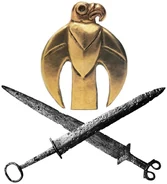
The Society’s research is comparative, because it has to be. The peoples of the Eurasian steppe left no written account of themselves, so what can be known of them is assembled from three kinds of evidence: the objects placed in their graves, the accounts written by the Greek world that observed them, and modern excavation.
What we work on
Our interest is in the arms, dress, ornament and metalwork of the Cimmerian, Scythian and Sarmatian worlds — how they were made, what they signified, and how forms and techniques moved between the steppe and the settled cultures around it.
Reconstruction is part of that enquiry rather than a display of its results. Building a blade, a harness or a garment to the surviving evidence tests what that evidence actually supports, and it is often the point at which a gap in the record becomes obvious.
How the work is grounded
The Society is advised by specialists in Scythology, Iranian studies and steppe archaeology.
Oleksandr Symonenko is a Corresponding Member of the German Archaeological Institute and a specialist in Sarmatian and Late Scythian archaeology, with forty excavation campaigns behind him in Ukraine, Moldova and Hungary.
Dr Hanna Vertiienko is a historian and archaeologist whose work on Scythian iconography and funerary practice is published in peer-reviewed journals, and who has excavated in Forest-Steppe Scythia and at the Greek settlements of the northern Black Sea.
The documentary side of this work — recording dispersed material so that it can be compared — is the Scythian & Sarmatian Digital Heritage Initiative.
Researchers working on related material are welcome to make contact at info@greek-scythian.org.